



- project name :Parisii QFS–CIRAS
- project number: CIR_251123323
- project start: aug 2026
- project manager: Jason R. Cooner
An Established Programme for Quantum-Tolerant, Asset-Backed and AI-Enabled Financial Infrastructure
Executive Summary
Parisii™ and the Council for Interdisciplinary Research and Applied Science (CIRAS), within the framework of the IIGO Initiative, have established and commenced an international strategic cooperation programme for the development, institutional validation and regulated deployment of a new generation of financial infrastructure.
At the centre of the Programme stands the Parisii Quantum Financial System (QFS™): an AI-first, quantum-tolerant and fully tokenized financial operating architecture integrating banking, payments, lending, trading, real-world-asset tokenization, regulatory compliance, settlement, risk management and autonomous financial services within a unified environment.
The CIRAS Institute contributes the interdisciplinary, scientific and public-policy capabilities required to evaluate and develop the QFS as infrastructure of international relevance. The IIGO Initiative provides the institutional framework through which dialogue and cooperation can be advanced with governments, central banks, financial authorities, research institutions, development organizations and responsible private-sector partners.
The Programme has now entered its initial institutional and technical phase. Joint activities are focused on defining the implementation architecture, establishing governance and scientific-assessment structures, identifying suitable regulatory jurisdictions, preparing priority use cases and organizing the pathway toward banking licences, governmental authorization, central-bank consultation and financial-market-infrastructure integration.
This cooperation represents a particularly strong framework for disruptive international technology. Parisii provides the financial architecture, intellectual property and implementation capacity. CIRAS contributes interdisciplinary validation, economic and societal analysis, scientific coordination and policy translation. The IIGO Initiative creates the international institutional frame within which the system may be introduced to sovereign and regulated stakeholders.
The Programme Mandate
The mandate of the Parisii QFS–CIRAS Programme is to establish a secure, regulated and internationally interoperable financial infrastructure for the tokenized economy.
The Programme responds to the convergence of three structural developments:
- The digitalization and tokenization of real-world assets;
- The emergence of artificial intelligence as an active participant in commerce and finance; and
- The growing requirement to protect financial and governmental infrastructure against future quantum-enabled cryptographic threats.
These transformations cannot be addressed through isolated applications. They require a coherent financial operating environment capable of connecting assets, institutions, identities, transactions, regulatory controls and settlement mechanisms.
The Programme has therefore begun work on an integrated institutional architecture through which the Parisii QFS can progress from advanced financial technology into regulated infrastructure serving governments, banks, enterprises, investors and authorized autonomous agents.
The Parisii Quantum Financial System

The Parisii QFS is a full-stack financial operating system designed to unify the principal functions of contemporary and emerging finance.
Conventional financial systems remain fragmented. Banking, payments, securities trading, lending, compliance, custody, risk management and settlement frequently operate through separate technologies and institutional processes. A single economic event may create multiple records across multiple systems, resulting in reconciliation delays, operational costs, fragmented oversight and avoidable risk.
The QFS addresses this fragmentation through a common transaction and data architecture.
The Unified Transaction
The foundational component of the QFS is the Unified Transaction. Every financial event is intended to generate one structured and authoritative record containing its complete economic, legal, compliance, settlement and audit context.
The Unified Transaction can represent:
- Deposits and withdrawals
- Domestic and international payments
- Bank and wallet transfers
- Loan applications, disbursements and repayments
- Primary asset issuance
- Securities and token trading
- Token exchanges
- Real-world-asset creation and transfer
- Staking and collateral operations
- AI-agent payments and commercial mandates
- Settlement and clearing events; and
- Compliance, reconciliation and audit actions
Each record incorporates the identities of the relevant parties, the asset and amount, transaction status, settlement rail, compliance decision, risk score, applicable fees, collateral information, external references and on-chain evidence.
The result is a common source of financial truth. Compliance, settlement, risk management and audit do not operate as disconnected processes; they become coordinated dimensions of the same financial event.
QFS Banking
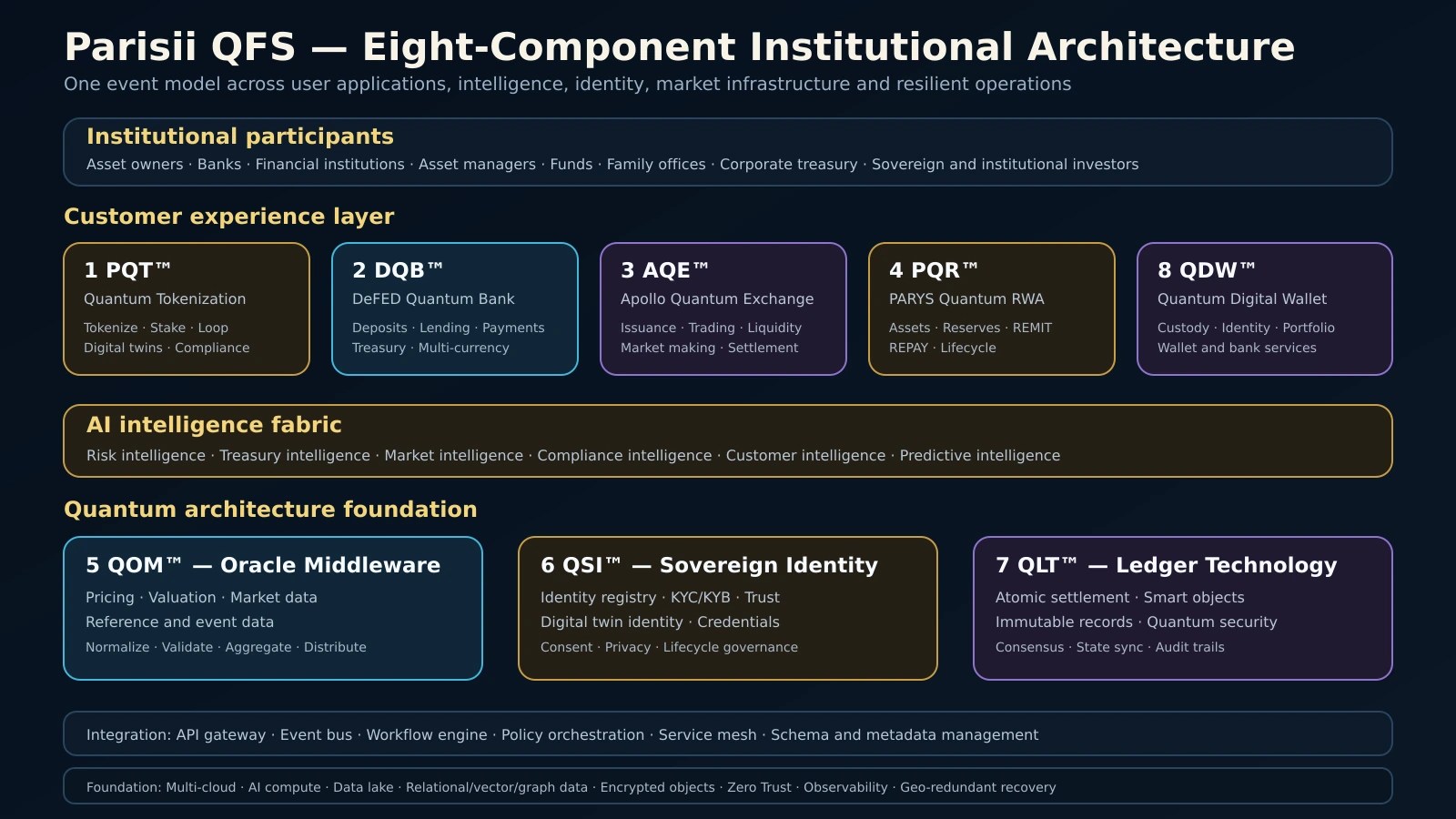
The banking layer provides the account, payments, lending and treasury capabilities necessary for institutional and commercial financial activity.
Its architecture supports:
- Multi-currency and multi-asset accounts
- Fiat and digital-asset deposits
- Withdrawals and transfers
- Digital wallets
- Domestic and international payments
- Recurring and scheduled transactions
- Personal, commercial and institutional lending
- Collateral management
- Loan servicing and repayment
- Treasury operations
- Liquidity monitoring
- Consolidated account and transaction reporting
The QFS is designed to interface with established payment and settlement mechanisms, including SWIFT, ACH, SEPA, CHAPS, Fedwire, real-time payment networks and compatible distributed-ledger systems.
Compliance is embedded within transaction execution. KYC, AML, sanctions screening and risk controls are intended to be applied before settlement. Transactions that do not meet the required conditions can be suspended, blocked, documented and escalated through the same operating environment.
This architecture enables regulation to function as part of the financial infrastructure rather than as an administrative process added after execution.
QFS Trading and Digital Markets
The QFS trading environment connects the issuance, exchange and lifecycle management of conventional and tokenized instruments.
It encompasses:
- Primary issuance
- Compliance-controlled subscriptions
- Secondary-market trading
- Institutional and over-the-counter transactions
- Token and currency exchange
- Market and limit orders
- Derivative and structured instruments
- Portfolio risk analysis
- Automated market surveillance
- AI-assisted and agentic trading
Human, institutional and AI-initiated transactions are subject to the same compliance, risk, audit and settlement requirements.
This is essential to the creation of institution-grade digital markets. Technological autonomy cannot become regulatory immunity. Every actor and every transaction must remain identifiable, authorized and accountable.
PARYS™ Quantum RWA Suite
The PARYS™ Quantum RWA Suite provides the real-world-asset digitalization and tokenization layer of the QFS.
Its purpose is to convert legally verified economic rights into secure and programmable digital instruments. Potential asset classes include:
- Real estate
- Infrastructure projects
- Gold and precious metals
- Commodities and natural resources
- Energy and sustainability projects
- Bonds and financial instruments
- Intellectual property and royalty rights
- Patents and licensing revenues
- Artificial-intelligence models and data rights
- Regulated cash-equivalent instruments
The Programme recognizes that tokenization must begin with legal and economic verification not with the creation of a token.
Before an asset enters the QFS environment, its ownership, valuation, custody, contractual rights, restrictions, insurance, encumbrances and economic performance must be documented. The corresponding digital representation must remain linked to this evidence throughout its lifecycle.
Each admitted asset will receive a unique identifier connecting the digital instrument with its legal documents, valuation history, ownership record and Unified Transactions. Transfers, distributions, collateral arrangements and corporate actions can consequently remain traceable and auditable.
The objective is to make real-world value more transparent, divisible, transferable and internationally accessible while preserving enforceable rights and institutional controls.
Settlement, Reconciliation and Asset Security
Settlement is incorporated directly into the QFS transaction architecture.
Every Unified Transaction records its settlement mechanism, counterparties, expected settlement time, current status and external references. Developments from initiation through processing, settlement, failure or reversal are maintained as successive state transitions.
This architecture supports:
- Real-time settlement monitoring
- Automated reconciliation
- Reduced duplication between systems
- Clearer transaction finality
- Faster identification of discrepancies
- Consolidated liquidity analysis
- Counterparty-risk management
- Regulatory and audit reporting from a common record
A major Programme priority is the secure integration of tokenized assets with established financial-market infrastructure. This includes trusted reference data, securities identifiers, investor rights, clearing, settlement, custody, corporate actions and reconciliation between traditional and distributed ledgers.
The Programme has therefore established market-infrastructure cooperation as a strategic workstream, including the preparation of technical engagement with DTCC and other qualified clearing, settlement and asset-servicing institutions.
Such engagement is intended to explore compatibility and potential cooperation. It does not represent an existing DTCC endorsement or formal integration until confirmed by the relevant institutions.
Agentic Finance
The QFS treats artificial-intelligence agents as identifiable and governable financial participants.
AI agents are expected increasingly to purchase services, manage commercial tasks, execute investment strategies, obtain data, initiate payments and transact with other authorized agents. Conventional financial systems were not designed to supervise these actors.
Within the QFS, every authorized agent is expected to operate under:
- A verifiable identity
- An identified institutional or human principal
- A legally defined mandate
- Transaction and exposure limits
- Approved payment and wallet authority
- Continuous compliance monitoring
- Real-time risk controls
- Explainable transaction records
- Emergency suspension
- Human override
Every agent action generates a Unified Transaction. This ensures that autonomous activity remains subject to the same standards of identity, compliance, audit and accountability as human or institutional activity.
The purpose is not to create uncontrolled autonomous finance. It is to establish a regulated infrastructure for responsible agentic commerce.

Quantum-Tolerant Security
Post-quantum security is a foundational requirement of the Programme.
Bank credentials, payment instructions, digital signatures, ownership records and governmental information may remain sensitive or legally relevant for decades. Information compromised or collected today may potentially be decrypted in the future when sufficiently capable quantum technology becomes available.
The Programme has therefore commenced the development of a cryptographic-resilience framework encompassing:
- Cryptographic asset inventory
- Post-quantum migration planning
- Hybrid classical and post-quantum protection
- Cryptographic agility
- Secure digital signatures
- Institutional key custody
- Hardware security
- Resilient network architecture
- Independent security testing
- Continuing adaptation to recognized international standards
Security will not be presented as an absolute or untestable guarantee. The QFS will demonstrate quantum tolerance through recognized cryptographic standards, documented controls, independent review and continuing migration capability.
CIRAS Institute and IIGO Initiative Contribution
The CIRAS Institute provides the Programme with an interdisciplinary platform extending beyond financial engineering.
The Institute contributes expertise across economics, governance, infrastructure, science, environment, international relations, justice, media, education and other fields relevant to the societal adoption of transformative technology.
Its responsibilities within the established cooperation include:
- Scientific and interdisciplinary assessment
- Economic-impact analysis
- Governance and policy development
- Ethical and public-interest review
- Institutional risk analysis
- Evaluation of pilot programmes
- Research coordination
- Governmental implementation studies
- Translation of technical findings into policy and institutional language
The IIGO Initiative provides the Programme’s wider international cooperation framework. Through this frame, dialogue can be developed with governments, central banks, regulators, universities, scientific institutions and development partners.
CIRAS remains in its formative institutional phase and does not presently claim formal intergovernmental status. The Programme will maintain full accuracy regarding the legal standing of all participating institutions.
Programme Goals
The established Programme is advancing the following principal goals:
- Complete the institutional and technical validation of the Parisii QFS.
- Establish the regulated operating structures required for banking, payments, custody, tokenization, trading and related financial services.
- Prepare and pursue banking licences and other necessary authorizations in selected jurisdictions.
- Obtain governmental approval for controlled pilot programmes involving legally verified assets.
- Develop structured consultations with the Federal Reserve, European Central Bank, Eurosystem and participating national central banks.
- Pursue technical cooperation with DTCC and other financial-market infrastructures concerning tokenized securities, trusted data, clearing, settlement and asset servicing.
- Establish an international standard connecting digital instruments with legal title, valuation, custody, ownership, compliance and audit evidence.
- Demonstrate a secure and accountable operating framework for AI-enabled financial services.
- Progress from controlled pilots to licensed institutional operation and international deployment.
These objectives form part of the Programme’s active work plan. They do not constitute external approval until the respective authority or institution has issued the appropriate written instrument.
Leadership
Jason R. Cooner, Chairman, President and Chief Executive Officer of Parisii, leads the QFS financial architecture and institutional strategy. His expertise encompasses large-scale banking infrastructure, financial interoperability, artificial intelligence, machine-to-machine economic systems and real-world assets.
Antonio J. Colón, Board Member and Chief Financial Officer, leads financial governance, capitalization, asset strategy and licensing preparation. His experience in accounting, audit, international transactions, energy markets and sustainable development supports the Programme’s financial and prudential foundations.
Gunther Sonnenfeld, Chief Technology Officer, leads the technical, cybersecurity, decentralized-finance and AI architecture. His work supports the integration of the QFS transaction system, PARYS assets, quantum-tolerant controls and external financial infrastructure.
Douglas R. Lee is a senior global executive, economist and institutional strategist with more than 25 years of experience leading organizational modernization, digital transformation and complex international programme execution.
CIRAS contributes its institutional leadership, scientific directors and interdisciplinary centers to the Programme’s research, governance, assessment and international-cooperation activities.
Together, this leadership structure brings financial engineering, systems architecture, institutional governance, sustainability and scientific coordination within one operational programme.
The Parisii Name

The Parisii name creates a symbolic connection between ancient monetary craftsmanship and modern asset digitalization.
The historical Parisii were a Gallic people established along the Seine. Paris ultimately inherited their name. Their gold staters remain among the most distinctive examples of Celtic monetary art transforming tangible gold into portable and collectively recognized representations of value.
Parisii’s corporate narrative associates the name with the Gaulish stem pario- “cauldron” one scholarly interpretation among several. Within the company’s mythology, the cauldron becomes the original “pot of gold”: a protected vessel containing real and enduring prosperity.
The PARYS Quantum RWA instrument carries this symbolism into the digital age. It is designed as a modern vessel through which verified economic value can be represented, protected and transferred.
The ancient Parisii transformed gold into recognized monetary form. The modern Parisii is developing the infrastructure through which real-world assets can become trusted and programmable financial instruments.
Programme Implementation
The cooperation has commenced with institutional coordination, technical assessment and regulatory planning.
The initial phase includes:
- Establishment of Programme governance
- Definition of the joint implementation architecture
- Selection of initial jurisdictions and use cases
- Security and compliance assessment
- Development of asset-admission standards
- Preparation of regulatory documentation
- Identification of governmental pilot partners
- Initial central-bank and market-infrastructure engagement planning
The subsequent phase will introduce controlled technical demonstrations and regulatory pilot environments. Subject to the necessary approvals, the Programme will then progress toward licensed operation, institutional integration and international expansion.
Strategic Conclusion
The Parisii QFS–CIRAS International Strategic Cooperation Programme is established and has begun its work.
It brings together the detailed financial operating capabilities of Parisii QFS, the interdisciplinary competence of the CIRAS Institute and the international cooperation frame of the IIGO Initiative.
Its objective is not merely to introduce another digital-finance platform. It is to establish a regulated, secure and internationally credible infrastructure for banking, real-world-asset digitalization, programmable settlement and AI-enabled finance.
The Programme proceeds from four governing principles:
Digital value must remain anchored in legally verified assets.
Financial automation must remain accountable to institutions and law.
International interoperability must preserve national and monetary sovereignty.
The financial infrastructure constructed today must remain resilient in the post-quantum era.
Through this cooperation, Parisii and CIRAS have commenced the construction of an institutional bridge between the established financial system and the emerging tokenized economy.


